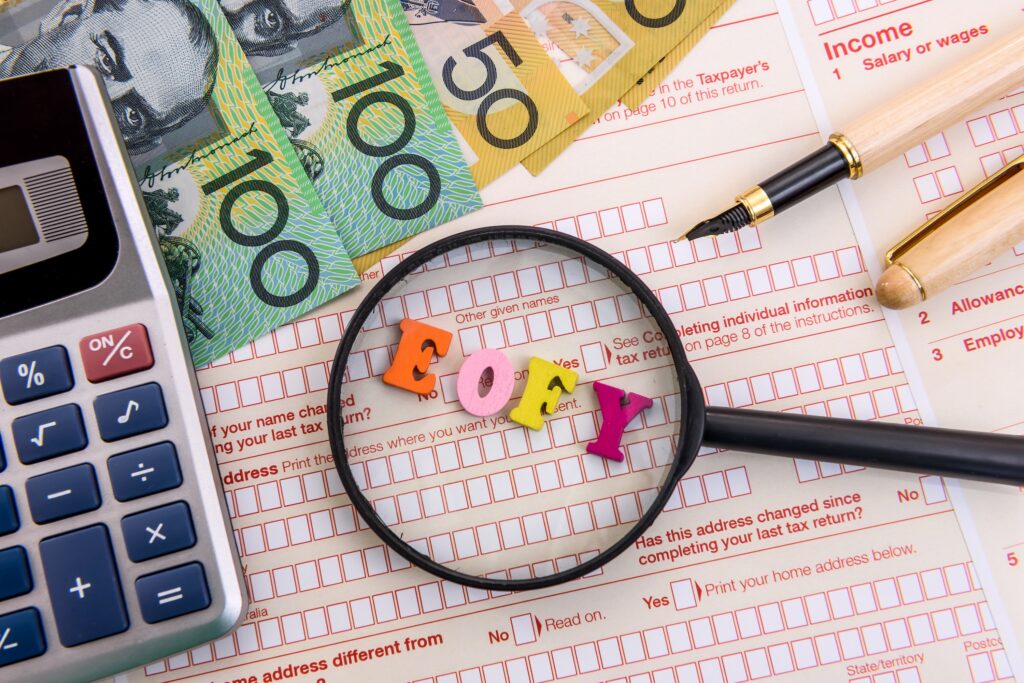
As the 2025–26 financial year draws to a close, you may feel pressured to get all your business paperwork completed, organised and ready for the ATO.
However, with proper planning and preparation, the end of the tax year does not have to be a complicated or stressful process.
This EOFY checklist brings together Numble’s end of financial year deadlines, small business tax tips and bookkeeping steps so you can close off your FY26 accounts, review your performance and start FY27 with clear numbers.
Whether you’re a sole trader, company director, not-for-profit manager or growing SME, EOFY is your prompt to get your financial house in order.
End of financial year need to knows
Let’s start with the basics: what is EOFY, when does it fall, and why is it important?
What is EOFY?
EOFY stands for End of Financial Year. Many people refer to it as “tax time” because that’s when businesses and individuals close off their accounts and prepare for their tax returns.
When is EOFY?
The tax year runs from 1 July to 30 June in Australia. That means EOFY falls on 30 June each year.
Why is EOFY important?
EOFY is all about signing off, closing the financial year and getting ready for the next. It’s time to get your house in order so you can review your business’s performance across the year and the ATO can confirm your business is operating above board.
Your bookkeeping, payroll, BAS, tax planning and financial reporting all form part of the process.
There’s no better time than the end of the financial year to file away the old and make way for the new, so your business starts the next financial year in a stronger position.
EOFY FY26 key dates and deadlines
Mark these dates in your calendar. Missing a deadline can cost you deductions, trigger penalties or delay your compliance work.
| Date | Deadline or obligation | What to do |
| 22 June 2026 | May 2026 monthly BAS | Lodge and pay if you report monthly. |
| 25 June 2026 | FBT annual return via registered tax agent | Applies if you have an FBT liability and your tax agent lodges electronically. |
| 30 June 2026 | End of financial year | Finalise FY26 transactions, deductions, stocktake and tax planning moves. |
| 30 June 2026 | Super contributions for FY26 deduction | Pay outstanding super early enough for contributions to reach the super fund by 30 June. This allows you to claim the super paid within the same financial year. |
| 1 July 2026 | Payday super begins | Super now needs to be paid at the same time as salary and wages. |
| 14 July 2026 | STP finalisation | Finalise Single Touch Payroll reporting so employee income statements can be marked tax ready. |
| 21 July 2026 | June 2026 monthly BAS | Lodge and pay if you report monthly. |
| 28 July 2026 | Q4 super guarantee | April to June super contributions must reach employee funds by this date. |
| 28 July 2026 | Q4 BAS for self-lodgers | Lodge and pay your June quarter BAS if you lodge yourself. |
| 25 August 2026 | Q4 BAS through a BAS or tax agent | Applies to eligible agent lodgements. |
| 28 August 2026 | Taxable Payments Annual Report | Lodge if your business must report contractor payments under TPAR. |
Payroll tax deadlines and thresholds vary by state and territory. Check your revenue office dates or speak with your bookkeeper if you employ staff across more than one state.
If you use a superannuation clearing house, including payments made through your accounting software, allow at least 10 business days for payments to process. Super is counted when it reaches the employee’s fund, not when you press pay.
Complete your record keeping activities
EOFY paperwork can seem endless, but it comes down to a few core jobs.
Profit and loss statement
Your profit and loss report summarises your income and expenses. It gives you clear visibility on how much profit your business made, or lost, during the financial year.
At tax time, you need to process all outstanding transactions so your accounts show real figures for sales, loans, expenses, depreciation, interest and other items.
At Numble, we provide clients with ongoing bookkeeping clarity, not just last-minute fixes. EOFY is smoother when your books are right all year.
BAS lodgements
You probably keep on top of your BAS throughout the year, so EOFY is simply your prompt to check lodgements are accurate and up to date. If not, it’s time to speak to your bookkeeper or the ATO about getting back on track.
Check and reconcile GST, PAYG withholding and PAYG instalments before your June monthly BAS or Q4 BAS is lodged.
Payroll and STP finalisation
You’ll need to reconcile your payroll to provide accurate payroll information to the ATO and your employees.
This means reconciling wages, PAYG withholding, super, leave entitlements, bonuses, allowances, deductions, reimbursements and payroll liabilities.
Most payroll reporting is now done through Single Touch Payroll. Employers who report through STP do not need to give employees payment summaries for the amounts reported and finalised through STP. Employees access their income and PAYG statement through their myGov account.
Before finalising STP, check and reconcile your payroll register, payroll activity report, super payments and ATO portal figures to ensure they match.
Stocktake
If you hold inventory, perform a stocktake by 30 June.
A stocktake means counting your products, goods or inventory and checking that it lines up with your stock control records.
Calculating the value of your trading stock allows you to record stock assets in your tax return accurately. It also helps you identify obsolete, damaged, slow-moving or low-margin items. This enables you to take timely action and manage your stock more effectively, ultimately improving your overall financial performance.
Accounting reconciliation tools
As you reconcile your accounts, you may want to use accounting software or reconciliation tools to save time, improve internal controls, reduce errors and reduce fraud risk.
Many accounting packages now offer bank feeds, where bank statement data is automatically imported into your accounting software.
Bank feeds are useful, but they are not perfect. Duplicate statement lines or omissions can occur. Users can also cause errors by manually adding or deleting transactions.
To keep your records accurate, compare your software to statements provided by your financial institution.
Maximise deductions before June 30
EOFY is your final window to claim legitimate business expenses that reduce taxable income for the year.
Most business expenses should be deductible when they are connected to earning business income and backed by records. Knowing what is deductible, and what is not, helps you avoid missed claims and ATO issues.
Use this snapshot as a starting point, then confirm the details with your accountant.
| Deductible item | Key condition |
| Prepaid expenses | May apply when the service period is 12 months or less. |
| Superannuation contributions | Must reach the fund by 30 June to count as an FY26 deduction. |
| Instant asset write-off | Eligible small businesses can use the $20,000 threshold for assets first used or installed ready for use by 30 June 2026. |
| Bad debts | Must be written off before EOFY. |
| Donations | Must be made to a deductible gift recipient. |
| Training and education | Must be work-related or business-related. |
| Professional fees | Includes accounting, bookkeeping and legal fees tied to the business. |
| Technology purchases | Hardware, software and cloud tools may be deductible under the right rules. |
| Home office costs | Fixed rate and actual cost methods require clear records. |
| Vehicle and travel costs | Must be business-related and supported by logs, receipts or other records. |
Home office expenses
You may have always worked from home, or you may now split time between home and the office.
Whatever your set-up, make sure you account for it as you wrap up EOFY. You may be able to claim the business-related portion of expenses such as electricity, internet, phone, rent, motor vehicle costs and the decline in value of office furniture and computers.
For 2025–26, the ATO fixed rate method uses 70 cents per hour worked from home. You must keep a record of actual hours worked from home and records showing that you incurred the running costs covered by the rate.
You can also use the actual cost method, but it needs more detailed records.
Equipment and software expenses
Like other capital spending, software and hardware can be tax-deductible.
For FY26, the $20,000 instant asset write-off applies to eligible small businesses. The asset must be first used or installed ready for use by 30 June 2026.
Assets costing $20,000 or more can still be placed into the small business pool and depreciated under the relevant rules.
Temporary full expensing has ended, so do not rely on old COVID-era asset rules when making FY26 claims.
Bad debts and old receivables
Review your trade debtors and follow up on overdue accounts.
Write off anything you do not reasonably expect to recover before 30 June. Bad debt write-offs can reduce taxable income, but they need to be real, documented and approved in your books.
Donations
EOFY is a good time to do good and record it correctly.
Only donations to deductible gift recipients are tax-deductible. Keep receipts showing the DGR name, donation amount and date.
Property donations may need extra records or a valuation, so check before claiming.
Division 7A and owner loans
If you have borrowed funds from your company, review any Division 7A risks before 30 June.
If loans are not handled correctly, amounts may be treated as dividends. Speak with your accountant before EOFY if you have director loans, shareholder payments or private use of company funds.
Super contributions
Super can be one of the most tax-friendly planning tools available to business owners.
For FY26, the concessional contributions cap is $30,000. Some people may also be able to use unused carry-forward concessional cap amounts from the past five financial years if they meet the rules.
Contributions need to reach the super fund by 30 June to count in FY26, so do not leave payments until the last minute.
Prepare your business for the new financial year
EOFY is not only about tax. It is also the right time to review your pricing, wages, systems, cash flow and business goals.
Changes to super
The super guarantee rate is 12% for 2025–26.
From 1 July 2026, payday super starts. Employers will need to pay super at the same time as salary and wages, with contributions reaching the employee’s fund within 7 business days of the payday.
Update your payroll settings, cash flow forecasts and internal payroll process before the first pay run in July.
Wage increases
Check for wage increases that may apply to your staff from the first full pay period on or after 1 July 2026.
The National Minimum Wage increases to $1,004.90 per week, or $26.44 per hour, from 1 July 2026. Minimum award wages also rise by 4.75% from the first full pay period on or after 1 July 2026.
This is a good time to run a payroll checklist so staff details, awards, classifications, super settings and leave balances are correct.
Price changes in your business
EOFY is a practical time to make pricing adjustments.
Review your costs against current market conditions and decide whether your prices still support your margins.
Your industry, product or service mix should guide whether prices need to rise, stay steady or shift by customer group.
Price changes in outgoings
Your monthly activity can also be reviewed from an expense view.
Take note of outgoing costs and supplier price changes. Look at what expenses you can delay, what you should bring forward and where you may be able to renegotiate.
Review supplier payment terms, bank loans, leases, credit cards and finance agreements.
Tax planning and business structure
The end of the financial year is the right time to assess your current financial position and talk to your Tax Accountant.
Think about whether you expect major changes in the next 12 months and plan around that information.
Set goals for the next period and review whether your business structure still fits your current situation.
You may also need to review trust distributions, company profits, owner wages, drawings, dividends, CGT events, insurance cover and cash flow.
Software and systems
July is often a good time to switch accounting systems.
For larger businesses, you may want to run a parallel trial of the new system alongside your current software. You can stop using the old system once you are confident the new system is working accurately for your business.
Numble specialises in Xero, MYOB, NetSuite and cloud-based bookkeeping systems tailored to your needs.
Meet with your accountant and bookkeeper
Book an appointment with your accountant and bookkeeper well before EOFY, where possible.
This gives you time to review business performance, clean up your accounts and make tax planning choices before 30 June.
Your tax advisor can provide a full review so you can maximise your tax position and plan for the new financial year.
Tax time can feel overwhelming for any business, no matter its size. But it does not have to be all-consuming.
Get your accounts reconciled and up to date to 30 June so your accountant can prepare your tax return accurately and give you the best tax advice for your business.
By working through this checklist and getting help where you need it, you can make EOFY simpler every year.
Do you need help preparing your accounts for end of financial year? Get in touch with Numble for expert bookkeeping help at every step of the way.
Take control today
If you need help with your books or want to understand your financials better, let’s chat to see how we can help.
Book an EOFY consultation: [email protected] | 1300 852 575