
The accounts receivables turnover ratio (A/R Turnover ratio) is a good indicator of your business’ collection times i.e. how often your business turns credit sales into dollars in the bank, in a given period. Businesses need to track this as a measure of cash flow expectations from credit sales. Changes in your debtor day average may be a sign that your accounts receivables trading terms need attention, or something is happening that needs your attention.
Calculating accounts receivable turnover ratio
The A/R turnover ratio is an average, determined by dividing your company’s annual credit sales by the average balance in accounts receivable at the same period.
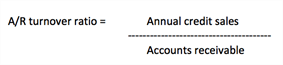
From this calculation, you’ll arrive at a figure that tells you how many times per year your business turns over its debtors.
Here’s a fictional example:
Barry’s Motorcycle Supplies makes $2,000,000 in credit sales a year and has a balance of $250,000 in accounts receivable at the end of that year. The A/R turnover ratio is 8.
(2,000,000 / 250,000).
In a 365-day year, Barry’s Motorcycle Supplies turns over its accounts receivables eight times, on average, or every 45.6 days (365 / 8), also known as Days Sales Outstanding.
How do you interpret the accounts receivable turnover ratio?
The A/R turnover ratio should be considered in the context of your other financial data. On its own, it does not paint a complete picture.
Other data that will help you interpret your A/R turnover ratio:
- Industry standard A/R turnover ratios or Days Sales Outstanding. Some industries are routinely slower to pay than others, so your business might be doing relatively well even though your ratio is low or vice versa.
- Previous A/R turnover ratios in the same business. Is your business collecting cash faster or slower than last year? Is this a one off or trending issue?
- Compare your collection time with your trade credit terms. If you’re consistently collecting past your agreed trading terms, you should look at tightening up your debt collection process and find other ways to get paid faster.
- Number of credit customers – fewer customers than the previous year may make your collections quicker, but fewer customers is generally not the goal of business. The reverse is true a significant increase in customers on credit may impact your debtor days.
- Value of credit customers – the ratio can be skewed if there are one or two exceptionally large customers with balances owing.
- Annual sales – quicker collection processes might improve the ratio, masking a decrease in sales.
- General economic conditions – if interest rates are higher than the previous year, businesses might expect a lower ratio as customers try to hold onto their cash for longer.
Improving collection times
An increasing ratio means your business is collecting cash from credit sales more frequently, and that’s good for cash flow. But remember, an increasing A/R turnover ratio can mask a decline in customer numbers or sales, so interpret any improvement in collection times in the context of overall growth.
Tips to improve collection times:
- Assess the credit history of new customers before issuing credit so that you are not unknowingly introducing credit risks into your business. Do a business credit check before approving credit terms.
- Issue invoices promptly and correctly so your customer has the opportunity to pay you on time.
- Make it really easy for customers to pay you by offering online payments: add a Payment Gateway link to your invoices and statements, allow your customers to pay immediately via credit card or EFT. Numble can help you activate Online Payment Gateways and Pay Now buttons.
- Reach every overdue debtor with payment reminders. Automation can make this job hands-free and very cost effective.
- Regularly review your trading terms, reducing your terms could significantly improve your debtor days, and the available cash in the bank.
- Investigate spikes—look for customer-specific issues such as an invoice dispute, or cash flow problem for your customer. Address these quickly.
- Be prepared to enact debt collection or legal recourse activities. Don’t wait until your client has disappeared and there’s no chance of getting paid.
Cash flow is a top concern for every small business owner. Accelerating cash recovery can drive your business further and faster.
AJ Singh, Managing Director, ezyCollect